As a test prep company with almost 30 years of experience, one of the most frequently asked questions we receive at Study Smarter is “Should I take the SAT or the ACT?”
Like most things having to do with college admissions, the honest answer is: “It depends!”
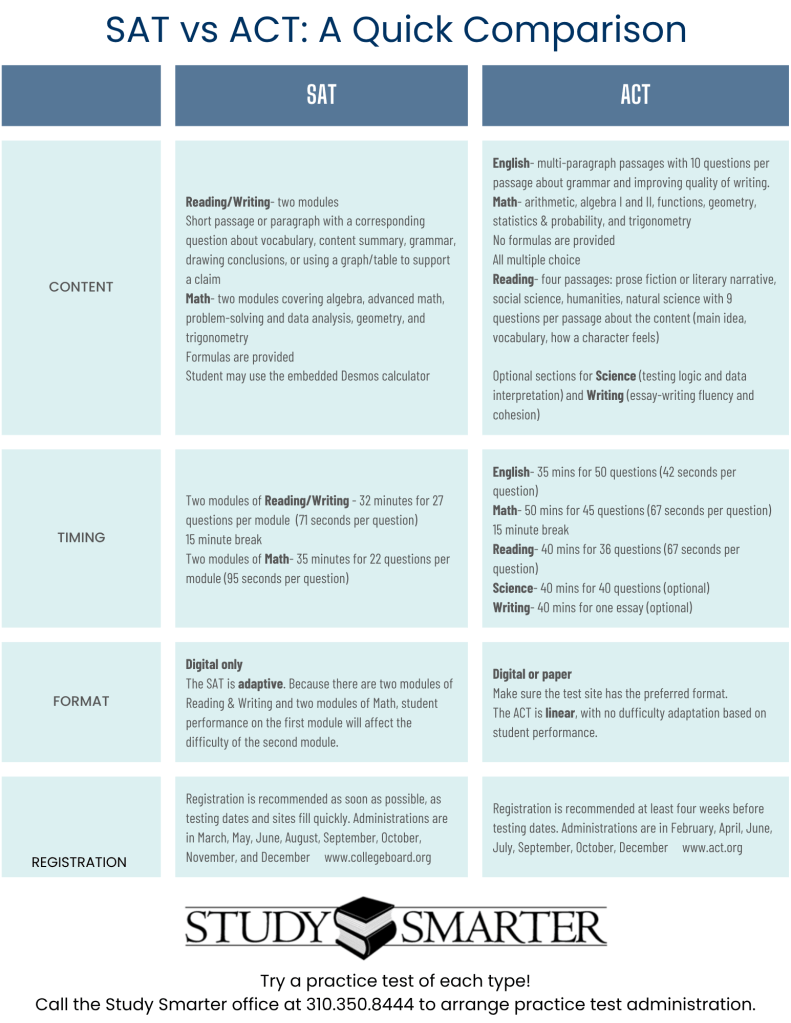
While we can use a handy comparison chart of SAT vs ACT for an overview, looking at each test in depth is a smart approach.
What do the SAT and ACT have in common?
Both the SAT and the ACT are content-based tests that are administered on specific days according to a specific timetable. These tests attempt to measure your aptitude and mastery of basic high school concepts like reading comprehension, vocabulary, grammar, mathematical fluency, and data interpretation. There is no penalty for guessing or marking an incorrect answer on either test. Any US college or university that accepts test scores will very likely accept either the SAT or the ACT, as they are both normed to US student standards.
(Are you curious if standardized tests even matter anymore in college admissions? Read our blog To Test or Not To Test to see why they might matter more than you think!)
There are significant differences, however, in the two standardized tests. Knowing these differences might help you determine which is the right test for you.
Test Format: SAT
The SAT is divided into four modules, two each of Reading & Writing and Math. The reading & writing modules have questions based on short passages (no longer than a paragraph or two) asking about vocabulary, summarizing ideas, grammar, and drawing conclusions. There may be a graph or a table that the student needs to use to determine what claim is being supported by the image.
There are 27 questions in each of the 32-minute Reading & Writing modules. If a student performs well on the first module, the passages and questions presented in the second module will be of a higher difficulty level.
The math modules of the SAT present a range of difficulties covering topics from pre-Algebra to Algebra II and Geometry. There are no questions from statistics or calculus. In general, the math on the SAT covers a narrow range of topics to a greater degree.
Like the Reading & Writing section, if a student does well on the first math module, the difficulty level will increase on the second math module. There are 22 questions per module, and students have 35 minutes to complete each module.
Note that the SAT Math is made up of both multiple choice and free response questions. For the free response questions, students must complete calculations and input their answer. The software for the SAT has a Desmos calculator built in. For students who know how to use this tool (and the formulas provided), this can be a tremendous help.
The SAT score is made up of Reading & Writing (up to 800) and Math (up to 800) for a total possible score of 1600.
Test Format: ACT
Starting in September 2025, the ACT will be made up of three required sections and two optional sections. The composite score of the ACT (up to 36) is composed of section scores on English, Math, and Reading– each with a possible score of 36. The Science section is now optional, and if students decide to take it the Science score (up to 36) will be reported alongside the composite score. There is an optional essay that is scored by two readers, each assigning a 1-6 score for a maximum score of 12.
Let’s take a look at the sections of the ACT. The English section questions the student’s ability to fix grammatical errors and improve the quality of writing in longer passages. There are 50 questions in this 35-minute section.
The ACT Math section is entirely multiple choice. The content spans pre-Algebra through Algebra II and Geometry, but it also includes topics like matrices, logarithmic functions, imaginary numbers, and sin/cosine. Compared to the SAT the topics are more broad but the depth of knowledge is shallower. Students must work more quickly, with 50 minutes to respond to 45 questions.
For the Reading section of the ACT, students are presented with four passages, usually of the following genres: prose fiction or literary narrative, social science, humanities, and natural science. For each of these four passages, nine content-focused questions are asked. Students must be able to discern the main idea, vocabulary, or even how a character may feel in a particular situation addressed in the passage. Historically, this has been the hardest section for students to finish, as each of the passages is about 600 words, and there are 36 questions to answer in 40 minutes.
The Science section is now an optional component of the ACT. It is 40 multiple choice questions with a 40 minute time limit. There are 6-7 passages that include tables, graphs, charts, or a text description of an experiment. Students then answer 5-8 questions per passage that require logical thinking or data interpretation skills.
Although the ACT Writing section is still available for students to take, there are only about 10 schools nationwide that require it. Check the admissions requirements for the schools to which you plan on applying before deciding whether to take the ACT Writing section.
As of Summer 2025, the SAT is available only in a digital format. The ACT is available either as a digital test or in the traditional paper format. Students should be aware of their preference when registering for the ACT, as not all test sites offer both formats.
Students With Accommodations
If you are a student who is approved for extra-time accommodations, this can be a more meaningful benefit on the ACT than on the SAT because of the rate with which the ACT test is administered. It is a faster test (meaning: you have less time per question to think and respond), so having extra time can make the ACT more coachable if time is the constraint you struggle with the most.
Registering for Standardized Tests
Registration is handled by the organizations that develop and own the tests. The SAT is a product of College Board, the folks who own the AP tests as well. The ACT is managed by its own non-profit organization, but it was acquired in 2024 by Nexus Equity Management.
Check with your high school to learn if there are school day administrations of either the SAT or ACT provided by your school or district. If so, this is a great opportunity to test without scheduling conflicts that sometimes arise with Saturday test dates.
Take Practice Tests!
Remember, this is only a surface-level comparison. If you really want to figure out whether you are better suited for the SAT or the ACT, taking practice tests is the best course of action. Call the Study Smarter office to inquire about arranging practice test administrations. Study Smarter test prep tutors have decades of experience helping students master test content, strategy, and confidence.








 Smarter Admissions
Leave a comment